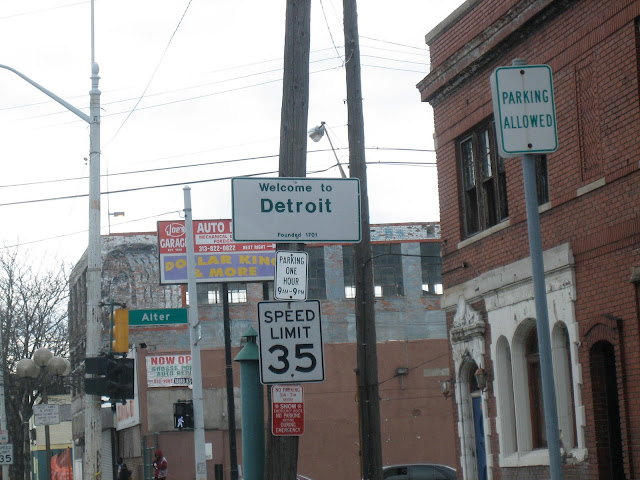
I'm reading a book called The Origins of the Urban Crisis. I bought it for my wife for Christmas, because I thought she would enjoy it, but it turned out to be a little more textbooky than I thought it would be(one reason not to buy books online).
Here's what I've learned:
Systemic structural discrimination laid the groundwork for the segregation of Detroit, the ghettoization of black neighborhoods and pervasive, lasting inequality. Vast numbers of blacks migrated from the South in the 1930's, 40's and 50's to northern cities like Detroit. This is what they found...
Detroit was the land of opportunity, the land of jobs, equality, hope. So to Detroit came the poor, the out-of-work, the landless. To buy a house you had to get a loan, to get a loan you needed the backing of the Federal Housing Administration (FHA) which based it's recommendations on the annual report of the Home Owner's Loan Corporation (HOLC). The HOLC rated neighborhoods from A-D. A being places they deemed safe bats and loan worthy, D being neighborhoods not worthy of receiving loan money. Every neighborhood with at least one black person in it was automatically rated D. So it was virtually impossible to get a home improvement loan in a black neighborhood.
Of course if you had money saved up you could buy a home, unless you were black. over 90% of the neighborhoods in Detroit had "white-only" clauses in their charters. (In fact, our community was barred from living in one neighborhood here because it has a vestigial-only one family per home-rule instituted originally under the assumption that most blacks couldn't afford to own a home by themselves to ensure a white only neighborhood after such overtly racial clauses were ruled unenforceable) And part of the guiding ethic of the national board of Realtors was to never assist in the disruption of the racial homogeneity of a neighborhood. In one area in north Detroit the FHA required a contractor to build a six foot concrete wall between the black and white neighborhoods to qualify for loans to develop land in the white section
So you rent. Of course due to the housing shortage in Detroit rent was expensive. And only a small fraction were open to blacks, and only a small fraction of those were open to adults. Landlords in the black sections of town subdivided homes and apartments, and increased rents. As buildings were converted from white to black the apartments got smaller and more expensive and the owners stopped maintenance.
Work was hard to get for black people. And when they did find it it payed less and was more dangerous.
And so stereotypes were reinforced with black neighborhoods becoming crowded, dirty, poor, dilapidated...And then the city government sought to clean up "blight". They built the freeways through the black areas of town, displacing residents to...even more crowded neighborhoods. And they tore down neighborhoods to build public housing, which reinforced segregation since they were all segregated through the 50's.
Enough details...this isn't a book report...I knew this all before I read the book, I just hadn't put it all together quite like this. But what I want to get across is this. The system was (and in many ways still is) stacked against blacks, the poor, and especially poor blacks. Structurally, from the federal government to the state government to the city government to community charters, to associations of bankers and realtors, to individuals bankers, homeowners, landlords...everything was (and in many ways still is) lined up in such a way to give advantage to those with money and those with white skin.
I didn't know this growing up. It took me a long time to figure out that racism today is an institutional as well as individual issue. But racial tension is so palpable in Detroit. The ongoing conflict between the suburbs (in between then and now most of the whites and the money left Detroit for the suburbs) and the city is clear. And the segregation and discrimination are still here, with money, resources and jobs concentrated in the mostly white suburbs.
Thursday, December 31, 2009


If you could be anything
Luthier
This is clearly one of the better words in the English language. Not only that, it is one thing I would like to be if I weren't going into medicine. Woodworking, music, Italy...it has all the makings of a great profession
This is clearly one of the better words in the English language. Not only that, it is one thing I would like to be if I weren't going into medicine. Woodworking, music, Italy...it has all the makings of a great profession
Saturday, December 26, 2009
Huzzah

Clayton Matthew. Born on Christmas Day.

Mr. B isn't sure what to think.

His mother likes him though.
Thursday, December 24, 2009
oranges and little boys

Mr. B likes clementines. Generally we peel them and cut them into bite sized pieces. He was rummaging through his mother's bag before we left the house and found his lunch. And he put his lone snaggle-tooth to good use.
Wednesday, December 23, 2009
U.S. NEWS
DECEMBER 22, 2009
In Detroit, Some See Grounds for Church Planting
New Evangelical Congregations Take Root in Depressed Areas, but City's Deep Burdens Sometimes Hinder Mission
http://online.wsj.com/article/SB126142947448500607.html#articleTabs%3Darticle
By ALEX P. KELLOGG
DETROIT -- Crime, unemployment and the housing crisis have chased thousands of people out of this city. But those are the very reasons Eric Russ moved in.
Mr. Russ is "lead visionary pastor" and one of the founders of the Mack Avenue Community Church, named for a long thoroughfare that cuts across the east side of Detroit. He and his congregation at "Mack Ave." represent a small, young corps of church organizers trying to spark a revival -- both spiritual and economic -- in this battered city.
The Revs. Eric Neilson, Leon Stevenson and Eric Russ of Mack Avenue Community Church shared a laugh before the service.
.."We wanted to go where people were forgetting God loved them," says Mr. Russ, 33 years old, who left an affluent church in suburban Cincinnati to move to Detroit two years ago, around the time the city's gradual decline spiraled into a full-blown crisis.
In the past decade, a movement often referred to as "urban church planting" has gained steam in evangelical circles. The aim: to build vibrant congregations and revitalize neighborhoods in frayed communities.
Detroit has long had a heavy concentration of churches for a city its size, and many of them assist the community by doing everything from donating bicycles to opening fast-food restaurants to create jobs. The area also is home to synagogues and mosques, some of which have begun offering assistance such as health-care clinics to members and nonmembers alike. Yet the economic downturn has strained the resources of many religious organizations.
Mack Ave. is among a handful of evangelical churches that have set up shop in Detroit and nearby communities. Their founders typically are transplants like Mr. Russ who say they feel called to help Detroit pull itself back from the brink. With financial support donated largely from churches outside Detroit, a few are beginning to thrive, in some cases creating pockets of rejuvenation in an otherwise decaying urban landscape.
Their success echoes efforts by evangelical churches in places such as Atlanta and Chicago, where new congregations have reinvigorated blighted areas.
But a city like Detroit poses unique problems for church planters. There are festering racial tensions that date back decades, a beleaguered urban infrastructure and, now, a regional economy on its knees.
Scott Thomas is director of Acts 29 Network, which helps found evangelical churches nationwide. He estimates that new churches generally take three to five years to establish themselves, but given the lack of resources in Detroit, "it would probably take seven years" for a new church to survive without funding from donors outside the city, he says.
Citadel of Faith opened its doors six years ago in a former synagogue in an ailing area near Boston Edison, a quaint historic neighborhood north of downtown. Founder Harvey Carey, a Chicago native, says he has lured a dozen families, both black and white, to move to near Citadel from outside the city. He says his church has helped close a handful of local drug houses by holding ad hoc services on their lawns until the dealers could no longer operate.
"I didn't know anything about Detroit," says Mr. Carey, 43. He spent 14 years as an assistant pastor at Salem Baptist Church on Chicago's South Side before moving here in 2003. "I had no connections here," he says of Detroit. "It was literally a spiritual directive."
Evangelical church Mack Ave. opened its doors on Easter Sunday in Indian Village, an upscale neighborhood on Detroit's east side. Its congregation of some 70 people is racially diverse.
Mr. Russ and his pastoral team count on a wide network of financial supporters -- churches from Ohio to Massachusetts to Nova Scotia as well as his old Cincinnati congregation -- to help cover the $600 monthly rent plus salaries for three pastors.
Still, young evangelicals who have moved to Detroit to join and help develop nascent congregations say the city can be a big adjustment. Last year, Jason McLean, 23, came to Detroit to join the Mack Ave. congregation from suburban Wayne, Mich., where he had lost several jobs and felt directionless, he says. He now lives in a church-owned house with three other young Mack Ave. members. He and his housemates, all in their 20s, prefer to have dinner parties at home than go out in Detroit at night, where they don't always feel safe, Mr. McLean says. "The lack of a police presence has been tough to see," he says.
Detroit wasn't founder Mr. Russ's first choice. The son of two drug addicts, he attended seminary in Massachusetts and spent time as a missionary in Uganda. After that, he took a job near Cincinnati and had planned to settle down there with a comfortable suburban congregation.
That changed after he and a small group of seminary classmates and other friends visited Detroit over Christmas three years ago. Local church leaders suggested Mr. Russ and his group focus on a particular neighborhood where they saw an acute need, and an opportunity.
While Mack Ave. was established in a historically affluent enclave, dilapidated neighborhoods that never recovered from 1967 riots surround the wealthy core. Just around the corner from the church are liquor stores, gas stations and empty storefronts.
Before the church opened its doors, Mr. Russ and his congregation spent a year and a half working in the community, focused on addressing basic needs. They offered backpacks of school supplies to children and sold toiletries and fresh fruit at street corners for pennies on the dollar. And before they had their own building, they began knocking on doors in search of parishioners.
Once he arrived in Detroit, Mr. Russ joined the neighborhood association in Indian Village and became a block marshal. He has purchased two homes in the area, rehabilitating one with the help of another church before selling it to a member of his congregation for little more than he bought it for.
More than a dozen families affiliated with Mack Ave., most from other states, ultimately purchased homes in the area and made improvements to them, hoping to demonstrate their intention to stay in Detroit.
But they are never far from the realities of Detroit. Mr. Russ once had his car stolen, only to recover it himself in a confrontation with thieves. Another Mack Ave. pastor, Leon Stevenson, and his wife were robbed at gunpoint in front of their home last fall.
Mack Ave.'s founders say they sense a lingering skepticism toward outsiders -- particularly whites -- who settle in the city. Indeed, a few of the founding members of the church ultimately left, deeming the divide too wide.
Tony Stec, 29, who attended seminary with Mr. Russ and worked as administrator of Mack Ave., left after less than a year. Mr. Stec, who is white, had racial epithets directed at him on the street, and says he ultimately felt unwelcome and unsafe. After deciding he didn't feel comfortable relocating his wife here, he took a job at a church outside Des Moines, Iowa, instead. "I wouldn't necessarily discourage anyone" from going to Detroit," says Mr. Stec. "But I would certainly preface it with the realization that it's going to be difficult."
Write to Alex P. Kellogg at alex.kellogg@wsj.com
Printed in The Wall Street Journal, page A19
Saturday, December 19, 2009
Reasons to live in Community-78, 2, 161
Number 78
You don't have to eat duck by yourself
I know this is basically a repeat of something I already said. Last weekend I wanted to cook a duck. Age wanted no part in an such endeavor. But since we live in community, I didn't have to eat duck by myself. The guys had duck and then played games, and the girls went out to dinner and a movie.
Which brings me to
Number 2
It's more fun
There is almost always someone to joke around with, hang out with, have serious conversation with, share a cup of coffee with...etc. It's more fun. And when you play games you aren't limited to chess or checkers. When you want o play raquetball you don't have to play against yourself. Killer Bunnies is the current hit game, though Settlers of Catan is the old standby.
Which brings me to an important corollary
Number 161
When you play the Settlers of Catan, you can always special build
Sunday, December 13, 2009
Reasons to love Detroit-3
It is what it is
Number 3
Detroit is like cutting your own Christmas tree.
Sure an artificial tree is nice...it has that perfect shape, you can store it for use again next year...There aren't any needles to sweep up, if you forget to water it it won't die...you don't have to tramp through the snow with a saw to get it, or spend half an hour on your back in a puddle of water tightening screws saying, "is it straight yet?"...when Christmas is over you just put it back in the box, or if you have room just carry it to the basement and cover it with a sheet...there aren't any holes and there's always a nice top branch for the angel or star...The branches are stright and never out of place...
but in the end it's still fake.
Monday, December 07, 2009
Reasons to love Detroit-16
Number 16
Noel Night
http://www.detroitmidtown.com/05/noelnight.php
Saturday Night we dropped Mr. B off at some friends house and went on our first real date in quite some time. So we headed off to midtown Detroit, and the 37th annual Noel Night. 40 different venues, live performances from kids dancing to a full production of The Messiah, to a lady with a guitar, to hip indie rock bands(MJ tells me that indie rock is the in thing, apparently we all love to be independent together).
The best thing is it's all free, except for food. The DIA had free admission, with several rooms devoted to performers. The library was a mass of people, there was an ice-sculpting competition, and caroling. Woodward Avenue was blocked off. One of the great things was the mix of people. And everybody was having a good time.
In the 70's the situation in Detroit was bleak. So it is not entirely surprising that some of the best events in Detroit date to that period...Noel Night, Dally in the Alley, the Detroit Jazz Festival...
The only problem is that the temperature was in the 20's. There are definitely not enough degrees in this place. So if you have any to spare, send them my way.
Sunday, December 06, 2009
Reasons to love Detroit
Number 7
Eastern Market
http://www.detroiteasternmarket.com/
Yesterday was a great day. Started out by going to EM with Age, Mr B and our neighbor. We filled a Radio Flyer to overflowing with fruits and vegetables sold at unbeatable prices, still mostly from local Michigan farmers(though harvest is basically over). In the next few weeks they will make the transition to almost entirely imported produce, but since EM is the distribution point for all the produce that goes out to south-eastern Michigan, the prices will still be drastically reduced.
It's Christmas season, which means a host of vendors selling trees, wreaths, and other assorted evergreen branches arranged into all sorts of shapes and sizes.
You can also buy meat from some vendors, including a whole pig head for 69 cents/pound if that's what you need.
Since 1891, it is the larges historic public market district in the country. Pretty cool.
Saturday, December 05, 2009
17 and 18
Reason number 17 tfor communal living:
When you don't have something you need, someone else does.
Example: I don't own a rolling pin. I also don't own one of those round dishes you use to bake pies. But that doesn't stop me from making pie. I don't know exactly whose rolling pin it is. I'd fifty-fifty chance it belongs to MJ or Mrs. Shoe. But who knows. Anyway. Pie is good
Reason number 18 for communal living:
When you make pie you don't have to make it by yourself.
Example: Blackberries were on sale at the market last week. One flat for 6 dollars. I bought two flats, turned one into 7 jars of jam and the other into a blackberry pie. And so we all had pie together.
Friday, November 27, 2009
Communal Living
Hey, so now that I remembered that I have a blog, I suppose I should give an update. I realize there's probably noone who reads this anymore, but in case someone stumbles upon this site ten years from now, carries it up from the google vault and dusts it off, I should give a brief summary of the missing 6 months.
Life has been busy. We moved into the VDP with 4 other people on the first weekend in may, began to become more involved in our church, MACC, found out the missus was pregnant, then a short while later I started the third year of medical school, which has been a wild ride all by itself.
There are 7 (almost 8) of us in the house. There are many reasons to live in community. I may at some point sit down and try to explain why we do. For now suffice to say we feel it has been a great experience.
And now the cast of characters in our little play.
1. me.
2. my wife. balloon like belly, about to pop. Ready for number two. SHe's the cook and cleaning lady rolled into one. As the only person in the house all day every day, she ends up doing the most work around the house. And everyone appreciates that.
3. Big B-15 months old now, acquiring an independent identity, standing, playing, moving around. Just popped his first tooth.
4. MJ-guitar playing engineer, good sport and general chief of new ideas. Part owner of Detroit's newest community garden, cook, part time meat smoker, and connoisseur of any and every thing you can be a connoisseur of.
5. The Sellinator-newly engaged hockey playing medical student. Deer killer extraordinaire, selfless dish washer and infective laugher. Once bounced a goldfish off a balloon and caught it in his mouth. Never hesitates to watch Big B by himself or with the Shoes to give the missus and I a break.
6. The Shoe-married to Mrs. Shoe. Would give you the shirt off his back if he thought you might ask for it. Game winner, peacemaker, appliance fixer, and king of racquetball. The kids next door knock every day and ask for the Shoe because he is the nicest person in the house and makes time for them.
7. Mrs. Shoe-married to the Shoe. PA student, graduates this spring. Gift giver, hard worker, queen of shopping, kind spirit. I have to say that Mrs Shoe is the person in this house most tormented by my idiosyncrasies, so I have to give her a shout out for her patience.
Thursday, November 26, 2009
Thanksgiving
This year we couldn't travel home for thanksgiving. We could have driven to Ann Arbor, but instead we decided to have thanksgiving meal here in Detroit with our neighbors.
The last time I wrote in this space we didn't even live in this house. Now we do...there are seven of us in the house with one more on the way. We have gotten to know our neighbors fairly well. So the half the house staying in Detroit decided to celebrate thanksgiving with them. We had a great time with our friends, it has been a blessing to get to know them over the last few months.
My contribution was a turkey and some mashed potatoes. We went out Monday night and bought all the materials for this

Yep you guessed it. A smoker made out of two flower pots and a hot plate and some wood chips and a grate. We considered trying to convert a weber grill or building it out of a metal trash can. In the end we went with the terracotta in an attempt to replicate a ceramic smoker. Here is the result:

I know it doesn't look like much, but it was delicious. The brine and the rub conspired to hold the moisture in, and the hickory smoke penetrated well. It was quite tasty. Of course smoked turkey doesn't really give that traditional turkey taste. So we roasted a turkey in the oven too. The only difficult thing about the meal was that one our housemates is a bit of an iconoclast, so he did his best to make sure that no tradition was left intact. But it all worked out. The turkey we did in the oven tasted just like it does every thanksgiving(the smoked turkey was good, but just didn't cut it for thanksgiving flavor), and the mashed potatoes and stuffing were good.
Also the little guy got dressed up for the party. All in all it was a good day.

Friday, May 01, 2009
Thursday, April 30, 2009
in addition
here's what the CDC has to say:
“Cover your nose and mouth with a tissue when you cough or sneeze. Throw the tissue in the trash after you use it.”
“Wash your hands often with soap and water, especially after you cough or sneeze. Alcohol-based hand cleaners are also effective.”
“Avoid touching your eyes, nose or mouth. Germs spread this way.”
“Try to avoid close contact with sick people.”
“You cannot get swine influenza from eating pork or pork products.”
yes indeed--wash your hands
The flu
I know that two of my sibling have complained about the treatment of swine flu in the hews over the last few days. I for one love it. I think it is hilarious.
I wish bird flu would make a comeback so that we could hear about both at once.
I especially love the interactive maps.
I mean under what other circumstances can you know exactly how many people have a disease at any given time?
I think the funniest thing is that people react to what they hear on the news. Come on you can't say it's not funny to see people wearing those masks around, and closing schools and all...like I said, hilarious...
But I do think they should start calling it the pig flu instead of the swine flu--more funny
Wednesday, April 29, 2009
Bird flu
A few days ago we were getting in the car and I was closing the door-as it closed a small flock of swallows swooped by and three ended up closed in the car. I looked up and one was closed in the door. It's head was outside and its body was inside. When I opened the door it fell at my feet-in the car...and the other three were still flapping around in the car.
Saturday, April 11, 2009
On schools and other things
The Detroit public school system recently announced that it is going to close another 50 schools in the next year or so. 23 are slated for closures this summer. 600 teachers will be laid off. An additional 30-40 will close next year. There are currently 194 schools in DPS. Over the last few years 70+ schools have closed.
A closed school represents a lot of money. Desks, Books, Chairs, etc etc. Unfortunately due to budgetary concerns most of that capital has been left in the schools to grow dust, acquire water damage, be vandalized etc. Why have so many schools been closed? there are many reasons. 1. population contraction. 2. charter school expansion (about a third of Detroit students are in charter schools)and the biggest reason:
3. money money money. The district just can't afford to keep the schools open. The state recently stepped in and appointed a new superintendent with all sorts of special powers and a special investigator to figure out the finances. Detroit has faced falling revenues for many years for two reasons; population contraction and the impoverishment of the city. Put simply: All the people who could afford to pulled up stakes and got the heck out of Dodge. Anyway, the investigator found an additional 100 million dollars in unpaid debt that the school district didn't know about. A whole stack of invoices stashed in a drawer somewhere.
So where does this leave the students? I guess there's not really any way to describe it...crowded classrooms, limited resources, violent hallways, violent classrooms, jaded teachers without resources or the incentive to actually teach. The dropout rate is over 50% in most high schools, literacy rates in Detroit are below third world levels.
Here are some snapshots:
On March 29, 2006, students at Mackenzie High in Detroit staged a walkout to protest the lack of textbooks and toilet paper. 32 were arrested, with 8 charged for disorderly conduct, and 1 for inciting to riot. Students complained that they had only one textbook per 3 students, an administrator had an expensive plasma television, amid allegations of a missing $3,000, and leaking roofs which damaged 45 new computers in storage.
On August 31, 2007, Detroit Public Schools announced that they have opened a Detroit Police mini-station in Henry Ford High School. Detroit Free Press article indicated that police mini-stations are planned for Cody, Cooley, Northwestern and Central high schools. [54] DPS maintains its own sworn and armed police officers.
So why am I saying all of this? I have a confession. I always assumed that it was possible for anyone to make it to the top in the United States. I always said, "yes there is inequality of outcome, but there's equality of opportunity. If someone born in a poor neighborhood wants to they can make it out." And it gave me a good feeling inside. It justified my lifestyle. It gave me a feeling of superiority. Somehow I was better for having chosen to be responsible with money and for having gotten a job and gone to college and pursued success. And it justified my not doing more to help people.
And so I guess my point is this: Equality of opportunity in this country is a myth. A kid who grows up with no education, with parents who weren't educated and don't know how to fight for him, with no prospect of a job, in a place that the rich have abandoned and left for dead, does not have the same opportunity to succeed that I did. I don't say that to condemn anyone, or to try to goad you to action. Most of the people who read this blog do more than I do to help people anyway. But I say it as a confession. I was wrong. And I am one of the rich who turn their backs on the poor.
When opportunity knocks...
2 Thessalonians 3:1 "Pray that the message of the Lord may spread rapidly and be honored, just as it was with you."
"There is great opportunity right now for the church to spread the word of God in the world and to bring those who are in darkness into light."
I am convinced that this statement is true, not just now, but always. We live in a broken world full of broken people...broken people who want to be made whole. I have been thinking a lot about this recently, and I think that if these people can't find the way to truth, the problem isn't them, it is the church. If we aren't connecting with people, we're not using the right words.
The Word of God is eternal--but the vast majority of what the church does to connect to the world isn't directly mandated in the Word. I am not aware of a directive that says this is what the church should look like--other than; it should be the temple of the Holy Spirit, the bride of Christ, the children of God in one body, united in worship. But the worldly part of us wants to be right, and wants to be in charge. We want everyone to look like us(whoever us may be). And so when the church reaches out to the world I think we try to transform the world into the image of our fathers rather than the image of our Father.
There are a lot of calls to lots of things in the Bible. But as far as I know there isn't anywhere in the Bible where it says that you have to sing a couple songs then pass the offering plate, then have a sermon then sing another song, and all stand up and sit down on cue. There also isn't any place in the Bible that I am aware of that it says that we should divide the church along racial and economic lines. I'm just sayin is all...
But back to my original point. There is a great task and opportunity to sow and reap. Now. But the church has to be willing to reach out to people who wouldn't be caught dead in most churches in this country. It has to be willing to reexamine what it means to worship. and ask the questions: Is the performance we put on every Sunday morning enough? Are we called to be a theater? Or is there something more we should be aiming for?
Don't get me wrong. The message can't change. The gospel is for all time. And the Word is eternal. But it just seems like sometimes we get the delivery all wrong.
Thursday, April 09, 2009
A review or two
I was thinking, it's been a while since I wrote a movie review...so I'll write two.
Slumdog Millionaire=exploitative cheesefest
One down one to go
Last night we watched a movie called Gone Baby Gone. I'm not sure what made me watch it. It's about a guy who finds people. In Boston.
Anyway, despite the fact that it had nothing going for it before it started, It turned out to actually be a pretty good movie. So here's the story. This girl gets kidnapped and her aunt goes to the media, and then hires this private investigator to find her. So he follows all sorts of twists and turns to try to find her. I really want to say how it ends, but I won't because I think it would ruin the suspense of the movie for all of you out there who are going to go out and rent it because I said it was good (Ok, I recognize that that number of people is probably close to zero).
Anyway, here's why I liked it.
1. a good well constructed plot. I could often guess what was going to happen next, but not more than maybe 30 seconds before it actually happened. So it wasn't super suspenseful, but it definitely had lots of unsuspected twists and turns. I don't like predictable movies (like SM).
2. It raised real issues and portrayed people actually struggling to figure out what the right thing to do is. The main issue of the movie is "Is it better for a child to live in poverty with their biological family, or in relative affluence with a family not there own? How about if their family leaves them alone at night, or does drugs? And if it is better, who gets to decide that? Can I as a person who cares about children decide to take a child from another family I judge to be doing a poorer job?" A secondary issue is "If the state isn't doing it's job, do the citizens have to right to do it for them? And are drug dealers bad people?"
Just kidding about that last one.
3. It portrays people making decisions about what is right, and acting on those decisions, and then it shows the consequences of those actions. In movies we don't often get to see consequences of real actions. I mean we get to see what happens if I lay 20 pounds of C4 under this building, but we don't get to see people having to clean up the mess. Hollywood often falls into the trap of skipping from action, to actions, to more actions...and we miss all the messiness. And the thing is, life is messy and dirty and painful.
So let's see how SM stands up:
1. What plot? Two kids grow up poor in India and end up making it in the world. One in a respectable job, the other in crime. Then one of them wins a million dollars because they happen to pick 10 questions he actually knows the answer to. I have to say the only unpredictable part of that movie was him jumping in poop.--cheesefest
2.Here's the exploitative part. It doesn't actually deal with any issues. The message of the movie is--hey look at all the poor people. Nobody has to make any decisions or face any consequences for anything.
All that said. SM was a fun movie. It's not bad to have a predictable story. And it's not bad for the good guy to win. It just doesn't make it a great movie.
Monday, March 30, 2009
A diversion
When I was writing that last post it went on too long and I go off on this diversion...so here it is.
Don't get me wrong--I do not want to malign St. Francis. But think about what he did to preach the gospel without words...he gave up the life of Italian nobility and he vowed to not own anything except for the tunic of coarse cloth, a rope to tie it around himself, sandals, and a begging bowl. He was even known to give up these things to help others. He reached out to the lowest members of society--lepers. And he lived the life of a vagabond. In fact if we saw St. Francis on the street today, most of us would consider it "lifestyle evangelism" to give him a few bucks.
In addition, he used words. He was clear about what he expected of his disciples, he taught, and he proclaimed truth in Christ.
But he didn't just do all of this to shock people and to make people ask him what it's all about. He spoke to real issues of his time--issues of inequality, materialism, greed. He did this to renounce the ways of the world, and to bring God's message to men. He left the cloister. He rejected the walls the church had built up around men of faith. And he walked, and walked, and walked, and talked to God, and talked to men, and showed people what real life can be. And when people came to him he taught them, and led them, and made them disciples of Christ.
So I think--if you're going to quote St Francis, you'd better be willing to make your life real. And to seek God's will, and to speak to the issues of our time and not hide behind the walls of the church. To get dirty, to get sick, to lose things, to lose time, to lose opportunity, to lose life.
Sunday, March 29, 2009
On lots of posts
Sorry for the volume of words here. I just got back, I've had a lot on my mind, and my wife is still in Florida, so whatever.
Word? or Deed?--what's it gonna be
We are called to two different things: To "feed the hungry, give water to the thirsty, invite the stranger in, clothe the naked, visit the sick and imprisoned." And to "go and make disciples of all nations, baptizing them in the name of the Father and the Son and the Holy Spirit, and teaching them to obey everything I have commanded you."
St Francis said: "Preach the gospel always and if necessary use words." The idea I think is that if you live your life in a Christ centered way people will see the light in you and be drawn to Christ. Then, as I have heard it said in many Christian circles, people will ask you, why are you so good--and you can then use words. As far as I can tell that's a load of hooey. I know that I for one have never been asked--why are you so great. That's probably because I'm arrogant, caustic, and, in fact, not all that good. But how about a show of hands. How often is it really that this works?
Words are necessary. I think it is absolutely essential to any mission to speak truth and to make clear the purpose of what we do. I think that most of the time when people begin to talk a lot about lifestyle evangelism (the idea you can convince someone that God exists by the way you live) what they mean is "I'm scared to acknowledge Christ because I think people might think less of me." At least that's what I mean when I start talking about lifestyle evangelism.
And Deeds are necessary. Christ called us to serve the down and out, the have-nots, the children, the needy. Over and over and over again he preached that message. And I don't think the point of good works is to bring people to Christ. He draws us to himself. The point of good works is to express our love for those who are made in the image of God (i.e. all human beings).
Words are not sufficient. James said faith without works is dead. We have to act on our faith and we have to be willing.
Deeds are not sufficient. Without faith, good works are just that. There are lots of people out there who do lots of good things without having any sort of faith. But ultimately they are still broken, without hope.
I guess what I'm trying to get at is that in Christ we are filled to overflowing with love for the things that God loves, and that the expression of that is to desire good things for those God has created. And so we preach the gospel to bring life and healing to the dead and broken, and we feed, heal, clothe etc those who cannot make it on their own. Word and Deed are the same thing. They are both essential and important.
In fact I think I can go so far as to say that without the other each one individually is exposed as a lie. We convince ourselves that we're ok--I preach the gospel, I don't have to feed the hungry--or I do good things for people and lead a good life, I don't have to preach the gospel. That is a lie. We are called by Christ to both feed the hungry and feed the hungry.
On labels
So I've been working on going back and labeling the blog entries I've written in the past, now that I've discovered that you can have your labels run down the side of your blog and people can click on them to search.
I do a few every week. So they're not done yet. And won't be for quite a while...but that's neither here nor there. But I have realized that I have written about a lot of topics.
I reported about a year and a half ago that there were no supermarkets in Detroit...I have to say I was relying on a News story, and it was completely false. There are all sorts of grocery stores in Detroit. True there are fewer than you would expect, and they're not really national chains. But they're here. So I formally retract my poorly researched and preachy post.
On garbage and other smelly stuff
Every time I've been to a garbage dump outside of the United States it has been a memorable experience. It always blows my mind that people live on the garbage dump, and work there and actually pick through the trash. And what really gets me is that nobody does anything. I mean there are enough resources in the world that nobody should have to pick through other people's garbage for a living. The only thing I can guess is that people don't realize it's going on. So I'm going to show whoever cares what it looks like. I can't wait until they figure out how to send smells over the internet. Because there isn't any way to explain what it smells like. I suggest though that you wait until your kitchen garbage can is pretty full...then stick it out in the sun for a few days. Then cut eyeholes in the bag and wear it around for a day(don't take the garbage out first). Then you can understand how it smells.

The biggest business on the dump is scrap metal. Other recyclable materials are also gathered and sold. Who do you sell scrap metal if you work on the dump? Well there's always the mob. Of course if you don't sell it to the mob--well what can you do--scrap metal doesn't taste very good. You can guess who gets most of the profit.

They built the school to keep kids off the dump. Unfortunately it doesn't always work that way.

One thing that gets me is the birds. Birds are ok far away. But up close they're dirty and gross. especially when they live by eating trash. And especially when they are vultures.

All sorts of waste gets deposited here. Including agricultural waste and pesticides, and hospital waste with needles and blood and all manner of things. It is not a safe place to grow up.
Saturday, March 21, 2009
Going to Honduras
I'm leaving today for Honduras. I'm going to work with an organization called International Samaritan that works with families that live and work on the garbage dumps in Central America. I'm going to San Pedro Sula where they are in the process of building a medical clinic which will be dedicated later this year. We're going to be doing a community health assessment and baseline exams to try to help them determine the most cost effective ways of improving the health of the people there.
I'm excited to go. I hope that it will be a good trip and that I can be reasonably useful to the people there. I am disappointed that I have to leave these two behind though:


I'm excited to go. I hope that it will be a good trip and that I can be reasonably useful to the people there. I am disappointed that I have to leave these two behind though:


Sunday, March 15, 2009
Jude the Obscure
So I wrote a group of posts on Jude last week--but I never got around to posting them. I think you can get them all in one place by clicking on the label at the bottom of the post. But of course by the strange rules of blogs, the first will be last and the last will be first.
Anyway, looking back a week later,I have a few more thoughts. One is that I need to remind you that I have no reason to expect anyone to listen to what I have to say, but it's been put on my heart so I'm saying it. Second is that I might be very wrong in what I said, and I am almost certainly a little bit wrong so feel free to say I don't know what I'm talking about.
Third is this:
When David wanted to atone for his sin after he took a census. He went to a man and said I want to buy your threshing floor to make a sacrifice. The man said it's yours, you're the king, take it and the wood and the oxen to make your sacrifice. And David said, no I will purchase it, for I will not offer a sacrifice to God that cost me nothing.
When Jesus spoke of the kingdom of heaven he likened it to a treasure in a field that a man found. When he found it he went and sold everything he had to buy the field.
Following Christ is something that carries a cost. It is a sacrifice that requires everything. When we sign on to fight with Christ, we enlist for a lifelong battle against the forces of evil in the world, both within ourselves and in the world. And the way to do that isn't to complain, or condemn, but to seek God, and reach out in grace and peace to those around us.
Saturday, March 14, 2009
On houses in Detroit
I couldn't believe the part about a house being sold for $2000. Unable to contain my curiosity I checked Zillow.com and sure enough, there are LOTS of houses going for
that, or less, and they don't look like they've been trashed nor do they appear to be located in slums and ghettos. I found one in Oak Park for $1000, three bedrooms and two bathrooms, completely updated kitchen and bathrooms, curb appeal... Wha...??????
So now I am REALLY curious. How can this be? What is happening that people are selling their homes for such a pittance? Is the Detroit area suffering from radiation poisoning? Weird mold infestation? Are the winters that bad?
A friend of me sent me this e-mail--it's a sentiment I've heard before, so I thought I'd comment on it. I'm no expert in the economics of home sales--but I think the etiology of this condition is interesting, so here goes.
1. Detroit's infastructure was built to accommodate 5 million people-mostly in single family dwellings. In the fifties, there were more single family homes in Detroit than in any other city in the world. Auto-industry jobs paid well, it was a growth industry, and almost all of the lower management, mid-management, and head honchos for all of the major auto companies worked and lived in the Detroit area.
2. The population topped out just under two million (some estimates say just over 2 million) in the late fifties, and now stands at a somewhere between 750-800 thousand. So there's a huge housing surplus.
3. In the late 90's and early 00's-when gas was cheap and SUV's were in, it looked like the auto companies might turn the corner. The city contracted out the demolition of some of the homes that had been abandoned, Then they convinced all sorts of people to invest heavily in building new housing--condos, apartments, lofts, townhouses. Then gas prices went up, and everybody realized that the auto companies were never going to make it out of the hole.
so a) there's a huge glut of housing in Detroit.
b) nobody in Detroit is confident they will have a job for very long. Even the Detroit Public Schools have had to close the doors of a number of schools to save money and pack more students into fewer classrooms.
c) housing prices are falling nationally anyway
d) the population of Detroit is still going down
e) forclosures have drastically reduced the price buyers have to pay for houses. Banks are unloading houses for a fraction of their former value, just to get them off the books.
On top of all this, taxes are not insignificant in Detroit. It is not uncommon for houses that are selling for 20,000 to have an annual tax bill of 10,000. And the city is very reluctant to lower the taxed value of the home. (an example of the impact of taxes here is the story of the restaurants on the block that was first announced as the location of the casino in town. Their property values shot up due to speculation, their tax bills went up, they went bankrupt, then the location was changed, but they stayed bankrupt and now there's a row of abandoned storefronts.)
The ripples of instability have spread out to neighboring communities, so that property values in nearby towns are also incredibly low.
It's a perfect storm of bad economic news.
Monday, March 09, 2009
Jude takes the gloves off
The more I read the less I understand. Let's push on to the end.
The last thing Jude says about these men is that they are "grumblers and faultfinders; they follow their own evil desires; they boast about themselves and flatter others for their own advantage."
So when I read this I see a picture of myself. I can't tell you how many times I've sat around complaining about one thing or another. That's why I always get sucked into politics--there's always something to criticize. And I think sometimes that I look actively for ways to talk about how great I am. I feel like David confronted by Nathan--"You are the man!"
And I think that's part of the point--Jude wants to say, don't give up the fight. There is in this world a persistent conflict between the City of God and the City of Man. between the church and the world. Between the kingdom and the earth. We are engaged, we are emissaries, we are the lampstand. So don't give up. Seek God, enter the fire again to refine yourself further. You aren't there yet.
And then he closes with encouragement--there will be evil men, you will face scoffers and men will try to divide you. But build yourselves up in holy faith and pray. Watch out for each other--Be merciful to those in Doubt, snatch others from the fire...
I don't know
Sunday, March 08, 2009
I knew it
Political pundits (an most politicians) are just children who happen to be articulate. Their adult bodies just hide their immaturity.
(I just wanted to see if I could put a link in my title)
(I just wanted to see if I could put a link in my title)
Saturday, March 07, 2009
Hey Jude
I'm just going to keep going. I don't know if It'll ever make it to publication. But let me preface this with "I don't really know what I'm talking about. I'm just writing what I've been thinking about the last few days.
These men take the truth of God and twist it so that they can use it to heap abuse on others.
So here are some more things Jude says
6. They have taken the way of Cain:
I understand this to mean, holding the best of everything for myself, and offering God what is left over
7. they have rushed for profit into Baalam's error
That is using whatever spiritual gifts and authority I have to bring profit to myself.
8. They have been destroyed in Korah's rebellion
I think this means that they have grasped at spiritual authority that is not theirs, and attempted to speak for God what he has not spoken
Then there is a whole list of descriptions that I don't have the wisdom to decipher. shepherds that feed only themselves, clouds without rain blown along by the wind, autumn treas, without fruit and uprooted twice dead, wild waves of the sea, wandering stars
So as I look at the church leadership that I have witnessed, I see the public voice of the church particularly engaging in 7 and 8, leaders profiting off their positions and gifts and attempting to grasp at temporal power by claiming to speak for God. Consider two examples:
7. People who use the gift of music that God gave them to write worship songs and profit off them. If you want to sing most worship songs at a church service have to pay the person who wrote the song, and the company that collects the money, and the recording company. A similar thing can be said about books. If you write a book to help people grow spiritually, shouldn't you offer it free online?
8. People who "speak for God" and claim that they know what political party God is rooting for. Strangely pastors of large churches who get involved in politics seem to get invited to be the president's spiritual adviser, or to sit on committees or to pray at inaugural addresses or whatever.
When I read 6 I think of the face of Christianity in this country. The vast mass of wealth that walls itself off and does its best to keep the poor people out. That keeps 95 % of its wealth and almost all of its best time for itself. Who has time to go help poor people, or preach the Word in love-I've got a job to do.
I recognize the irony here. I am of course guilty of the very thing I railed against in my last post on the subject. I apologize. Let me be clear though--I think this is just as much an indictment of myself as anyone else.
Friday, March 06, 2009
Who reads Jude anyway
Not very many people. It's kind of wedged in with 2 and 3 John between the more popular 1 John and the more controversial Revelation. I mean, come on, its only 25 verses long. but I noticed today, that it has a pretty potent message-at least I think it does.
We are instructed to contend for the faith. To fight for truth and righteousness and to uphold the cause of Christ.
Part one is a description of a certain sort of person:
1. Who have slipped in among you--we're talking specifically about people in the church.
2. Who change the grace of God into a license for immorality.
3. and and deny Jesus Christ-our only sovereign and Lord.
Ok-so far so good. This should be easy. Just look for the dreamer who
4. pollute their own bodies, reject authority, and slander celestial beings
So far, I thought--I don't even know what you're talking about Jude. I mean--I don't know anyone who goes around saying, "celestial beings are sons of goats" So at about this point my eyes blink and I miss the rest of the book. Lots of people on the other hand pollute all sorts of things and reject God's authority.
Of course, that's when it gets interesting
5. these men speak abusively against whatever they do not understand, and what things they do understand by instinct-like unreasoning animals-this is what destroys them
What if this is an indictment of much of the church today in the United States. I guess I've heard a fair amount of abusive language directed against all sorts of things by Christians. "What, you're a (you could really insert Republican or Democrat here)--well that's just not Christian." Or "you want to live in the city among the poor--well that's just trendy and exhibitionist." or "you live in the suburbs among the wealthy--well that's just selfish and uncaring." or "you think The Shack is better than Pilgrim's Progress--you clearly aren't studying the Word enough."
I don't know--It just seems to me like there's an awful lot of invective and vituperation (yes I know it's pretentious, but it's just a synonym of invective) out there. and a lot of it is coming from Christians. It seems like the church should be a place that people come to when they need love. A place that dispenses grace.
So It seems like Jude is saying "Hey guy's don't make it bad--take a sad world and make it better."
Grace takes what is evil and sinful and makes it whole in Christ. So maybe we have a responsibility to reveal the grace of Christ to the world. To reach out in love and peace rather than judgment and hatred. Look, the world is still going to reject Christ and his followers. But if we follow the example of Christ then we reverse the tide and respond to rejection with love. You know--turn the other cheek and all that other stuff.
Thursday, March 05, 2009
On skin
So we're studying dermatology. One thing I've noticed that is a little bit different about this unit is that every lecturer finds it necessary to somehow insert into their lectures, justification for their ridiculous choice of a profession. There's generally one of two routes.
The first can be summed up, "mo money, no problems" Several lecturers had pictures of themselves on vacation--in Greece, Italy, China etc, and one talked for five minutes about how all his kids went to Harvard, others talked at length about how they never have to go into the ER and how they make lots of money.
The second can be summed up "melanoma". At least half the lecturers mentioned skin cancer and its role in their practice. One guy played this clip
Of course there was the one guy who admitted that most of Dermatology is cosmetic work--Botox, chemical peels, scar removal, etc.
Yep the best and the brightest, the doctors who did the best on their board scores and had the best recommendations--making us look better each and every day
PS GOOD THING HE HAS A WIFE TO SECRETLY CHANGE HIS BLOG AND ADD VIDEO!!!
Sunday, March 01, 2009

On Brigands, toughs, and a band of thieves
I was reading today in 1 Samuel--you know, that book in the Bible. Anyway, I happened to be reading about David. He gets a lot of press, what with killing the giant and all. He also gets a lot of press for watching Bathsheeba take a bath. But the story between the whole "save people from goliath" episode, and the coronation is intriguing. So in the story he's on the run from Saul, the king. He's hanging out in the desert with his band of merry men, doing whatever it is guys with swords and no jobs do--namely kill threaten, steal and the like. He ends up a a hired gun(or sword) for the enemy of the Israelites (his peeps) and eventually volunteers to fight against his own people, the men he once commanded in the army. In between there's the incident with Nabal and Abigail. David sends messengers to Nabal asking for food and supplies. Nabal says, why should I give you help, you're just a brigand. So David decides he is going to kill Nabal and every male in his household. That is until in fear, Abigail sends out the supplies David asked for because she knows he's really a ruthless thief who will kill her husband to get some food. So then David decides not to kill Nabal, but Nabal dies anyway, then DAvid marries Abigail and carries her off to the desert with him.
So anyway, what's the point. As I was reading I was thinking, this is the same story you hear over and over again in history. Some upstart general gets too big for his britches and take his followers off on a wave of pillage and destruction, then tries to take over the throne. It happens anytime there are too many soldiers and not enough jobs.
So I guess the point I'm trying to make, is I always thought that David was this great guy--you know, a man after God's own heart. He was the king, the psalm writer. But he was also a thief, an armed robber, a thug, an adulterer. So where's the rub?
I think one thing that I draw out of this isn't that it's cool to kill some dude, and take his sheep and his wife.
Instead I see God using a regular guy--who is selfish, sinful, etc--to accomplish his ends. To bring his people together, to set the stage, and to encourage his people through the Psalms. And I also see a man who though he continually did things I wouldn't dream of doing, he feared God, and he continued to seek God's will, and he maintained a life of submission to God and his prophets. And I think hey if God can use somebody whose first thought (and action) in conflict resolution is to kill, and who went through wives like sets of clothes, then maybe he can use me somehow, someway
Thursday, February 26, 2009
Money Money Money
1.5 trillion dollars is a lot of money.
A penny weighs 3.1 g, so if you had that in pennies it would weigh 465,000,000,000 kg. So given a density of 8.96 g/ml that makes 5189732142 square meters. so if you had a stack of pennies one meter tall, and one mile wide it would be 3243582 miles long--that's enough to wrap around the earth 135 times, or alternatively, you could build thirteen, 1 mile wide towers of pennies to the moon. (
Being the president is kind of like being Robin Hood. You get to steal from the rich to give to the poor. Except it's also kind of like being the Sheriff of Nottingham because you get to pocket a lot of coin. Bill Clinton for example makes more that a 100,000 dollars an hour giving speeches-and it's all tax free. You also get the pleasure of taking money from the rich-then letting them pay lobbyists lots of money to get it back again.
You also get to feel like to banker in monopoly--oh what-we're out of 1,000,000,000,000 dollar bills, let me just go make some more out of construction paper and tape.
Then at the end of the day you get to feel like a successful shopper just back from the mall--sure the defecit is a couple trillion now, but we'll only be 500,000,000,000 dollars a year in the red--so I'm like totally saving tons of money.
Tuesday, February 24, 2009
Things I like about living in Detroit
Not having to drive 45 minutes to school every day.
The YMCA--42 foot climbing wall, and raquetball courts
Waking up every morning to the sunrise over the river
Mack Avenue Community Church--keeping it real serving the people of Detroit
Liquor stores that accept food stamps
Mexicantown--great food like being home again
Not living in the suburbs
Did I mention not having to drive home at the end of the day
Sunday, February 22, 2009


Subscribe to:
Posts (Atom)