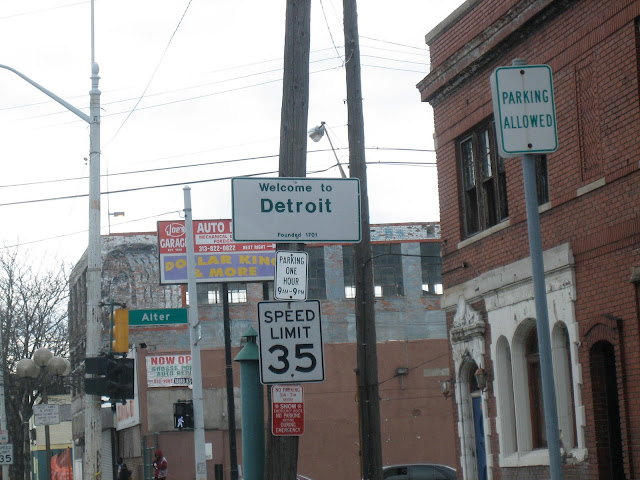
I'm reading a book called The Origins of the Urban Crisis. I bought it for my wife for Christmas, because I thought she would enjoy it, but it turned out to be a little more textbooky than I thought it would be(one reason not to buy books online).
Here's what I've learned:
Systemic structural discrimination laid the groundwork for the segregation of Detroit, the ghettoization of black neighborhoods and pervasive, lasting inequality. Vast numbers of blacks migrated from the South in the 1930's, 40's and 50's to northern cities like Detroit. This is what they found...
Detroit was the land of opportunity, the land of jobs, equality, hope. So to Detroit came the poor, the out-of-work, the landless. To buy a house you had to get a loan, to get a loan you needed the backing of the Federal Housing Administration (FHA) which based it's recommendations on the annual report of the Home Owner's Loan Corporation (HOLC). The HOLC rated neighborhoods from A-D. A being places they deemed safe bats and loan worthy, D being neighborhoods not worthy of receiving loan money. Every neighborhood with at least one black person in it was automatically rated D. So it was virtually impossible to get a home improvement loan in a black neighborhood.
Of course if you had money saved up you could buy a home, unless you were black. over 90% of the neighborhoods in Detroit had "white-only" clauses in their charters. (In fact, our community was barred from living in one neighborhood here because it has a vestigial-only one family per home-rule instituted originally under the assumption that most blacks couldn't afford to own a home by themselves to ensure a white only neighborhood after such overtly racial clauses were ruled unenforceable) And part of the guiding ethic of the national board of Realtors was to never assist in the disruption of the racial homogeneity of a neighborhood. In one area in north Detroit the FHA required a contractor to build a six foot concrete wall between the black and white neighborhoods to qualify for loans to develop land in the white section
So you rent. Of course due to the housing shortage in Detroit rent was expensive. And only a small fraction were open to blacks, and only a small fraction of those were open to adults. Landlords in the black sections of town subdivided homes and apartments, and increased rents. As buildings were converted from white to black the apartments got smaller and more expensive and the owners stopped maintenance.
Work was hard to get for black people. And when they did find it it payed less and was more dangerous.
And so stereotypes were reinforced with black neighborhoods becoming crowded, dirty, poor, dilapidated...And then the city government sought to clean up "blight". They built the freeways through the black areas of town, displacing residents to...even more crowded neighborhoods. And they tore down neighborhoods to build public housing, which reinforced segregation since they were all segregated through the 50's.
Enough details...this isn't a book report...I knew this all before I read the book, I just hadn't put it all together quite like this. But what I want to get across is this. The system was (and in many ways still is) stacked against blacks, the poor, and especially poor blacks. Structurally, from the federal government to the state government to the city government to community charters, to associations of bankers and realtors, to individuals bankers, homeowners, landlords...everything was (and in many ways still is) lined up in such a way to give advantage to those with money and those with white skin.
I didn't know this growing up. It took me a long time to figure out that racism today is an institutional as well as individual issue. But racial tension is so palpable in Detroit. The ongoing conflict between the suburbs (in between then and now most of the whites and the money left Detroit for the suburbs) and the city is clear. And the segregation and discrimination are still here, with money, resources and jobs concentrated in the mostly white suburbs.
Thursday, December 31, 2009


If you could be anything
Luthier
This is clearly one of the better words in the English language. Not only that, it is one thing I would like to be if I weren't going into medicine. Woodworking, music, Italy...it has all the makings of a great profession
This is clearly one of the better words in the English language. Not only that, it is one thing I would like to be if I weren't going into medicine. Woodworking, music, Italy...it has all the makings of a great profession
Saturday, December 26, 2009
Huzzah

Clayton Matthew. Born on Christmas Day.

Mr. B isn't sure what to think.

His mother likes him though.
Thursday, December 24, 2009
oranges and little boys

Mr. B likes clementines. Generally we peel them and cut them into bite sized pieces. He was rummaging through his mother's bag before we left the house and found his lunch. And he put his lone snaggle-tooth to good use.
Wednesday, December 23, 2009
U.S. NEWS
DECEMBER 22, 2009
In Detroit, Some See Grounds for Church Planting
New Evangelical Congregations Take Root in Depressed Areas, but City's Deep Burdens Sometimes Hinder Mission
http://online.wsj.com/article/SB126142947448500607.html#articleTabs%3Darticle
By ALEX P. KELLOGG
DETROIT -- Crime, unemployment and the housing crisis have chased thousands of people out of this city. But those are the very reasons Eric Russ moved in.
Mr. Russ is "lead visionary pastor" and one of the founders of the Mack Avenue Community Church, named for a long thoroughfare that cuts across the east side of Detroit. He and his congregation at "Mack Ave." represent a small, young corps of church organizers trying to spark a revival -- both spiritual and economic -- in this battered city.
The Revs. Eric Neilson, Leon Stevenson and Eric Russ of Mack Avenue Community Church shared a laugh before the service.
.."We wanted to go where people were forgetting God loved them," says Mr. Russ, 33 years old, who left an affluent church in suburban Cincinnati to move to Detroit two years ago, around the time the city's gradual decline spiraled into a full-blown crisis.
In the past decade, a movement often referred to as "urban church planting" has gained steam in evangelical circles. The aim: to build vibrant congregations and revitalize neighborhoods in frayed communities.
Detroit has long had a heavy concentration of churches for a city its size, and many of them assist the community by doing everything from donating bicycles to opening fast-food restaurants to create jobs. The area also is home to synagogues and mosques, some of which have begun offering assistance such as health-care clinics to members and nonmembers alike. Yet the economic downturn has strained the resources of many religious organizations.
Mack Ave. is among a handful of evangelical churches that have set up shop in Detroit and nearby communities. Their founders typically are transplants like Mr. Russ who say they feel called to help Detroit pull itself back from the brink. With financial support donated largely from churches outside Detroit, a few are beginning to thrive, in some cases creating pockets of rejuvenation in an otherwise decaying urban landscape.
Their success echoes efforts by evangelical churches in places such as Atlanta and Chicago, where new congregations have reinvigorated blighted areas.
But a city like Detroit poses unique problems for church planters. There are festering racial tensions that date back decades, a beleaguered urban infrastructure and, now, a regional economy on its knees.
Scott Thomas is director of Acts 29 Network, which helps found evangelical churches nationwide. He estimates that new churches generally take three to five years to establish themselves, but given the lack of resources in Detroit, "it would probably take seven years" for a new church to survive without funding from donors outside the city, he says.
Citadel of Faith opened its doors six years ago in a former synagogue in an ailing area near Boston Edison, a quaint historic neighborhood north of downtown. Founder Harvey Carey, a Chicago native, says he has lured a dozen families, both black and white, to move to near Citadel from outside the city. He says his church has helped close a handful of local drug houses by holding ad hoc services on their lawns until the dealers could no longer operate.
"I didn't know anything about Detroit," says Mr. Carey, 43. He spent 14 years as an assistant pastor at Salem Baptist Church on Chicago's South Side before moving here in 2003. "I had no connections here," he says of Detroit. "It was literally a spiritual directive."
Evangelical church Mack Ave. opened its doors on Easter Sunday in Indian Village, an upscale neighborhood on Detroit's east side. Its congregation of some 70 people is racially diverse.
Mr. Russ and his pastoral team count on a wide network of financial supporters -- churches from Ohio to Massachusetts to Nova Scotia as well as his old Cincinnati congregation -- to help cover the $600 monthly rent plus salaries for three pastors.
Still, young evangelicals who have moved to Detroit to join and help develop nascent congregations say the city can be a big adjustment. Last year, Jason McLean, 23, came to Detroit to join the Mack Ave. congregation from suburban Wayne, Mich., where he had lost several jobs and felt directionless, he says. He now lives in a church-owned house with three other young Mack Ave. members. He and his housemates, all in their 20s, prefer to have dinner parties at home than go out in Detroit at night, where they don't always feel safe, Mr. McLean says. "The lack of a police presence has been tough to see," he says.
Detroit wasn't founder Mr. Russ's first choice. The son of two drug addicts, he attended seminary in Massachusetts and spent time as a missionary in Uganda. After that, he took a job near Cincinnati and had planned to settle down there with a comfortable suburban congregation.
That changed after he and a small group of seminary classmates and other friends visited Detroit over Christmas three years ago. Local church leaders suggested Mr. Russ and his group focus on a particular neighborhood where they saw an acute need, and an opportunity.
While Mack Ave. was established in a historically affluent enclave, dilapidated neighborhoods that never recovered from 1967 riots surround the wealthy core. Just around the corner from the church are liquor stores, gas stations and empty storefronts.
Before the church opened its doors, Mr. Russ and his congregation spent a year and a half working in the community, focused on addressing basic needs. They offered backpacks of school supplies to children and sold toiletries and fresh fruit at street corners for pennies on the dollar. And before they had their own building, they began knocking on doors in search of parishioners.
Once he arrived in Detroit, Mr. Russ joined the neighborhood association in Indian Village and became a block marshal. He has purchased two homes in the area, rehabilitating one with the help of another church before selling it to a member of his congregation for little more than he bought it for.
More than a dozen families affiliated with Mack Ave., most from other states, ultimately purchased homes in the area and made improvements to them, hoping to demonstrate their intention to stay in Detroit.
But they are never far from the realities of Detroit. Mr. Russ once had his car stolen, only to recover it himself in a confrontation with thieves. Another Mack Ave. pastor, Leon Stevenson, and his wife were robbed at gunpoint in front of their home last fall.
Mack Ave.'s founders say they sense a lingering skepticism toward outsiders -- particularly whites -- who settle in the city. Indeed, a few of the founding members of the church ultimately left, deeming the divide too wide.
Tony Stec, 29, who attended seminary with Mr. Russ and worked as administrator of Mack Ave., left after less than a year. Mr. Stec, who is white, had racial epithets directed at him on the street, and says he ultimately felt unwelcome and unsafe. After deciding he didn't feel comfortable relocating his wife here, he took a job at a church outside Des Moines, Iowa, instead. "I wouldn't necessarily discourage anyone" from going to Detroit," says Mr. Stec. "But I would certainly preface it with the realization that it's going to be difficult."
Write to Alex P. Kellogg at alex.kellogg@wsj.com
Printed in The Wall Street Journal, page A19
Saturday, December 19, 2009
Reasons to live in Community-78, 2, 161
Number 78
You don't have to eat duck by yourself
I know this is basically a repeat of something I already said. Last weekend I wanted to cook a duck. Age wanted no part in an such endeavor. But since we live in community, I didn't have to eat duck by myself. The guys had duck and then played games, and the girls went out to dinner and a movie.
Which brings me to
Number 2
It's more fun
There is almost always someone to joke around with, hang out with, have serious conversation with, share a cup of coffee with...etc. It's more fun. And when you play games you aren't limited to chess or checkers. When you want o play raquetball you don't have to play against yourself. Killer Bunnies is the current hit game, though Settlers of Catan is the old standby.
Which brings me to an important corollary
Number 161
When you play the Settlers of Catan, you can always special build
Sunday, December 13, 2009
Reasons to love Detroit-3
It is what it is
Number 3
Detroit is like cutting your own Christmas tree.
Sure an artificial tree is nice...it has that perfect shape, you can store it for use again next year...There aren't any needles to sweep up, if you forget to water it it won't die...you don't have to tramp through the snow with a saw to get it, or spend half an hour on your back in a puddle of water tightening screws saying, "is it straight yet?"...when Christmas is over you just put it back in the box, or if you have room just carry it to the basement and cover it with a sheet...there aren't any holes and there's always a nice top branch for the angel or star...The branches are stright and never out of place...
but in the end it's still fake.
Monday, December 07, 2009
Reasons to love Detroit-16
Number 16
Noel Night
http://www.detroitmidtown.com/05/noelnight.php
Saturday Night we dropped Mr. B off at some friends house and went on our first real date in quite some time. So we headed off to midtown Detroit, and the 37th annual Noel Night. 40 different venues, live performances from kids dancing to a full production of The Messiah, to a lady with a guitar, to hip indie rock bands(MJ tells me that indie rock is the in thing, apparently we all love to be independent together).
The best thing is it's all free, except for food. The DIA had free admission, with several rooms devoted to performers. The library was a mass of people, there was an ice-sculpting competition, and caroling. Woodward Avenue was blocked off. One of the great things was the mix of people. And everybody was having a good time.
In the 70's the situation in Detroit was bleak. So it is not entirely surprising that some of the best events in Detroit date to that period...Noel Night, Dally in the Alley, the Detroit Jazz Festival...
The only problem is that the temperature was in the 20's. There are definitely not enough degrees in this place. So if you have any to spare, send them my way.
Sunday, December 06, 2009
Reasons to love Detroit
Number 7
Eastern Market
http://www.detroiteasternmarket.com/
Yesterday was a great day. Started out by going to EM with Age, Mr B and our neighbor. We filled a Radio Flyer to overflowing with fruits and vegetables sold at unbeatable prices, still mostly from local Michigan farmers(though harvest is basically over). In the next few weeks they will make the transition to almost entirely imported produce, but since EM is the distribution point for all the produce that goes out to south-eastern Michigan, the prices will still be drastically reduced.
It's Christmas season, which means a host of vendors selling trees, wreaths, and other assorted evergreen branches arranged into all sorts of shapes and sizes.
You can also buy meat from some vendors, including a whole pig head for 69 cents/pound if that's what you need.
Since 1891, it is the larges historic public market district in the country. Pretty cool.
Saturday, December 05, 2009
17 and 18
Reason number 17 tfor communal living:
When you don't have something you need, someone else does.
Example: I don't own a rolling pin. I also don't own one of those round dishes you use to bake pies. But that doesn't stop me from making pie. I don't know exactly whose rolling pin it is. I'd fifty-fifty chance it belongs to MJ or Mrs. Shoe. But who knows. Anyway. Pie is good
Reason number 18 for communal living:
When you make pie you don't have to make it by yourself.
Example: Blackberries were on sale at the market last week. One flat for 6 dollars. I bought two flats, turned one into 7 jars of jam and the other into a blackberry pie. And so we all had pie together.
Subscribe to:
Posts (Atom)