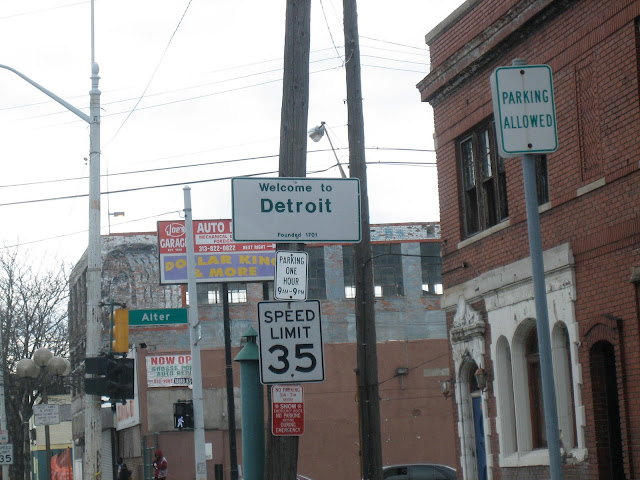
I'm reading a book called The Origins of the Urban Crisis. I bought it for my wife for Christmas, because I thought she would enjoy it, but it turned out to be a little more textbooky than I thought it would be(one reason not to buy books online).
Here's what I've learned:
Systemic structural discrimination laid the groundwork for the segregation of Detroit, the ghettoization of black neighborhoods and pervasive, lasting inequality. Vast numbers of blacks migrated from the South in the 1930's, 40's and 50's to northern cities like Detroit. This is what they found...
Detroit was the land of opportunity, the land of jobs, equality, hope. So to Detroit came the poor, the out-of-work, the landless. To buy a house you had to get a loan, to get a loan you needed the backing of the Federal Housing Administration (FHA) which based it's recommendations on the annual report of the Home Owner's Loan Corporation (HOLC). The HOLC rated neighborhoods from A-D. A being places they deemed safe bats and loan worthy, D being neighborhoods not worthy of receiving loan money. Every neighborhood with at least one black person in it was automatically rated D. So it was virtually impossible to get a home improvement loan in a black neighborhood.
Of course if you had money saved up you could buy a home, unless you were black. over 90% of the neighborhoods in Detroit had "white-only" clauses in their charters. (In fact, our community was barred from living in one neighborhood here because it has a vestigial-only one family per home-rule instituted originally under the assumption that most blacks couldn't afford to own a home by themselves to ensure a white only neighborhood after such overtly racial clauses were ruled unenforceable) And part of the guiding ethic of the national board of Realtors was to never assist in the disruption of the racial homogeneity of a neighborhood. In one area in north Detroit the FHA required a contractor to build a six foot concrete wall between the black and white neighborhoods to qualify for loans to develop land in the white section
So you rent. Of course due to the housing shortage in Detroit rent was expensive. And only a small fraction were open to blacks, and only a small fraction of those were open to adults. Landlords in the black sections of town subdivided homes and apartments, and increased rents. As buildings were converted from white to black the apartments got smaller and more expensive and the owners stopped maintenance.
Work was hard to get for black people. And when they did find it it payed less and was more dangerous.
And so stereotypes were reinforced with black neighborhoods becoming crowded, dirty, poor, dilapidated...And then the city government sought to clean up "blight". They built the freeways through the black areas of town, displacing residents to...even more crowded neighborhoods. And they tore down neighborhoods to build public housing, which reinforced segregation since they were all segregated through the 50's.
Enough details...this isn't a book report...I knew this all before I read the book, I just hadn't put it all together quite like this. But what I want to get across is this. The system was (and in many ways still is) stacked against blacks, the poor, and especially poor blacks. Structurally, from the federal government to the state government to the city government to community charters, to associations of bankers and realtors, to individuals bankers, homeowners, landlords...everything was (and in many ways still is) lined up in such a way to give advantage to those with money and those with white skin.
I didn't know this growing up. It took me a long time to figure out that racism today is an institutional as well as individual issue. But racial tension is so palpable in Detroit. The ongoing conflict between the suburbs (in between then and now most of the whites and the money left Detroit for the suburbs) and the city is clear. And the segregation and discrimination are still here, with money, resources and jobs concentrated in the mostly white suburbs.
Showing posts with label books. Show all posts
Showing posts with label books. Show all posts
Thursday, December 31, 2009


Tuesday, March 06, 2007
A Review: The Bonfire of the Vanities
It's ironic that Steven used this as a post title; I had this post ready to go and it somehow got deleted about a week ago.
Suffering is a basic element of human existence. We do our best to ignore it when we can, and we try to avoid it when we can no longer deny it. It is generally only the truly desparate or introspective who recognize its place in our lives. It is a deep and strong psychological force, even when we refuse to recognize its existence. Most of the vices of men are sought, at least in part, in an effort to alleviate this suffering: avarice, gluttony, envy, lust, pride, even anger is a response to perceived injustice. Suffering has been a basic component of the human condition since the arrival of sin in the world. Our separation from God entails suffering. Even in the post Christ age we still inhabit a fallen world.
Tom Wolfe's work rests on the recognition of this fact. In each of his works that I have read the main character begins the story in the flight from suffering. Over the course of the novel, they are slowly forced to recognize its existence and eventually embrace it as a fundamental piece of their identity and existence. This storyline lends itself to incredibly moving tales when woven by the master storyteller that Wolfe is.
The Bonfire of the vanities is no different. It is divided roughly into thirds: a comedy of errors in which McCoy goes to ever increasing lengths to protect the myth of his own greatness; the tragic and methodical unravelling of the web of lies he has surrounded himself with; and a heroic tale of of his struggle to reconcile himself to reality and at the same time stand up and fight. He undergoes a fascinating transformation from a weak--though emminently successful--disembler, into a strong--though eminently unsuccessful--human being with a firmer grasp on the reality of life.
The story is a tale of facades, some crumbling, some rising some to protect from the self, some to protect from the outside, but all ultimately designed to shield ourselves from the recognition that suffering exists.
Tuesday, December 12, 2006
On Dostoevsky
Of all the Russian authors I've read, I think Dostoevsky is my favorite. I read Crime and Punishment a few years back, and I've been reading the Brothers Karamazov recently. His stories center on the issue of guilt. Both stories are about murder. In C and P the main character (Rashkalnikov?) kills and old woman and robs her to regain a pawned watch. This happens relatively early in the story and as the novel unfolds he is eaten away by his guilt until he confesses to the murder at the climax. BK is more of a mystery. Fyodor is killed and robbed, and all of the evidence points to his son Dimitri. As Dostoevsky presents the case, there is no conclusion we can draw other than that Dimitri has killed him despite his protestations (I'm not done yet, the trial is about to start).
These two characters are worthy of disgust, and are presented in the most unfavorable light. And yet it is impossible for me to do anything but sympathize with them and pity them. This is masterful storytelling at its best. I'm still trying to figure out how he does it. Somehow he manages to link these characters to me by their humanity, to open a window into what is universal in the human condition (guilt) and to convince me without saying it that I am them but for a matter of degree (don't worry Dad, its a pretty big degree).
Tolstoy on the other hand fails in this very exercise by my estimation. In Anna Karinina for instance, though I am told by Oprah that I should pity Anna, I can't. Instead I identify with Levin. Though I did enjoy the book.
Subscribe to:
Posts (Atom)