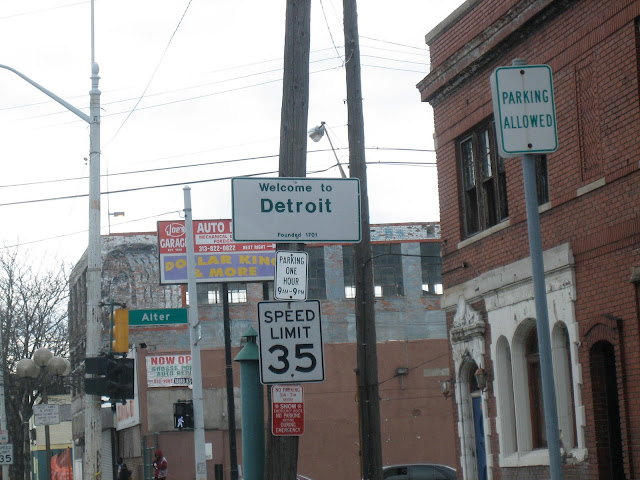
One thing about Detroit is that it has unique features you might not find in other cities. Other places don't necessarily have so many interesting sites. And this is all in an afternoon.
Where else can you move into an abandoned building today just by calling a number.
Where else can you find a church named after the pastor?
I grew up driving by crosses on the side of the road at most sharp turns. Thismemorial takes it to a whole new level. It is in memory of a girl who died two months ago when she crashed into this tree. Apparently they brought out all her belongings and stapled them to this tree.
Tuesday, April 27, 2010
Sunday, April 25, 2010
Friday, April 23, 2010
Sprouts!
The garden is coming along. It's fun to see things growing that were little seeds a few weeks ago. The guy who lives in the house adjacent to the garden has graciously offered us a hose and a functioning spigot, and he is taking over a small plot to grow his collard greens and peppers...because greens just aren't the same with out a little hot peppers.
I can occasionally convince Adrienne to go along with my crazy ideas--she painted the sign:
And some of the seeds are sprouting:
I can occasionally convince Adrienne to go along with my crazy ideas--she painted the sign:
And some of the seeds are sprouting:
Spinach planted by Jane
Peas planted by MJ
And the seedlings that Earthworks gave us are starting to go in the ground. These had outgrown their small little seedling containers. When I planted them they were all wilted and laying on the ground. So we watered them, and ten minutes later...
Ok, so they're still a little wilted, but they look even better now
Thursday, April 22, 2010
Housefire
I watched this house burn yesterday. I didn't have the camera with me. It's quite a sight to see a house burn. I was hot standing a block away. The flames are bigger than you think they would be. I always thought firefighters had a chance, but I've realized that once the house really gets going they're just protecting the house next door.
This is the third house I've seen burn in the last year and a half...I'd never seen one before then.
I think the house that was on the land where we have the garden burned. I keep finding charred bits all over the lot.
Wednesday, April 21, 2010
health and well being
One thing about living in and working in Detroit is that you can't help gaining a deeper understanding of the inequalities in our society. The patients I work with at the hospitals here--particularly Detroit Receiving--highlight the vast gulf between the educated, resourced elite, and the underresourced underclass.
An example: For most American women, the annual exam--or at least biannual is an assumed right. In fact when the USPSTF recommended that women really don't need quite as many pelvic and breast exams as they have been getting, there was a public uproar--despite the fact that these recommendations were based in empiric research.
Last week a 40 year old woman came into the clinic complaining of pain and irregular bleeding for the last year. She had come to the ER twice, and been diagnosed with benign conditions and sent home. On her third visit, someone finally took the time to sign her up for a free program that screens women for cervical cancer. It turns out that her last visit to the doctor was 15 years ago. She knew that she needed to come, but she didn't really have the education to know why, and she never had insurance, so she did what most people without insurance do and came to the ER when she couldn't stand it anymore. In Michigan two groups of people qualify for medicaid--children and pregnant women.
Turns out she had inoperable cervical cancer. So she will have an extended course of radiation treatment and maybe chemotherapy and so forth for several years, then the odds are that she will die.
So here's the way I see this scenario: We as a society and as a medical profession failed to provide this woman with the basic preventative health care she needed, and so now we will end up paying many times what prevention or early treatment would have cost us to give her a treatment that has a relatively low chance of long term success and gives her all sorts of miserable side effects.
Labels:
cancer,
health care,
inequality,
insurnance,
poverty
Wednesday, April 14, 2010
The Heidelberg Project (#14)
The Heidelberg Project is one of the most visited sites in Detroit. Tour buses roll by on a regular basis. In 1986 this guy named Tyree Guyton got fed up with his neighborhood and sick of waiting for the government to clean it up. In 1986 the neighborhood was just another example of Detroit's broken social structure dominated by crack houses and prostitution. So Guyton got neighborhood kids and his family together and started cleaning uop the neighborhood. They made big piles of trash...then he turned it into a giant piece of instalation art. He started with polkadots...and painted an entire block of trash heaps wih bright colors...then he moved on to other works. In 1991 and again in 1999 the city of Detroit demolished part of the project...it seems that certain mayors are more sensitive to criticism than others.
Guyton's work has been featured in museums around the world over the last 10-15 years, and his movement is increasingly recognized as one of the landmarks of Detroit...something like 300,000 people visit it a year.
The stuffed animal house
I thought the mission statement and vision statement were worth reading...ambitious.
The Heidelberg Project is a Detroit-based community organization designed to improve lives and neighborhoods through art.
The Heidelberg Project envisions neighborhood residents using art to come together to rebuild the structure and fabric of under-resourced communities and to create a way of living that is economically viable, enriches lives, and welcomes all people.
Death Camels
Friday, April 09, 2010
Things to love about Detroit #11
11. Optimism: I guess you learn to see the silver lining when it's always cloudy...or I guess you learn to see the glass as half full when somebody else is drinking all your water every time you fill the glass.
To announce the fact that GM lost 4.3 billion dollars in six months the Free Press chose the headline:
Signs of Hope at GM for it's print edition.
No seriously though, if you spend enough time around here you begin to realize that everybody has a plan to make things better. And it's hard not to be optimistic...I mean really there's not much room to go down...
For a good example, here is the Free Press again...
Big Plans for the Future of Detroit
Subscribe to:
Posts (Atom)